


Reading a seminar on training junior jumpers

Concepts and methodologies for training young jumpers
summary :
This document outlines the fundamental principles and modern methodologies for training young track and field athletes, specifically in jumping events. The material adopts a perspective that the real progress in recent decades has not been in the "information" itself, but rather in the "concept of its application" and understanding the interrelationship between the various elements of the training process. The methodology focuses on a "reverse engineering" strategy, which begins by defining the ultimate goal and then planning how to achieve it, emphasizing the importance of "intensity" over "volume," and the crucial role of the central nervous system and recovery in achieving peak performance. The document highlights the case of world champion Duplantis as a model for performance development through maintaining technical consistency while developing supporting physical abilities.
First: The general perspective of training (concept versus information)
The effectiveness of training depends on understanding how to apply theoretical information in practice. The main problem facing trainers is not a lack of information, but rather a failure to grasp the connection between the exercise and the ultimate goal.
The four parts of the general concept of training:
- The goal (reverse engineering): First, determine the desired level to reach, and then organize the exercises, repetitions, and training volume based on this goal.
- Total load: Understanding the physical requirements of world-class levels (such as a jump of 8.20 meters or a sprint under 10 seconds) and how juniors reach these numbers.
- Training methods and techniques: Logical linking between exercises; each exercise must serve the ultimate goal and not contradict it.
- Training conditions: Emphasizing that environmental conditions or lack of resources are not an obstacle to achieving world-class results if the right understanding and sound planning are in place.
Second: Bio-motor Abilities and Power Systems
The training consists of essential vital skills that must be understood in terms of how they interact to serve the competitor:
- Velocity: The primary driver for approach distances.
- Power: Used to perform dynamic and explosive movements during ascent.
- Endurance: The ability to repeat a movement with the same efficiency in multiple attempts (such as the sixth attempt in a jump).
Energy and healing systems:
Jumping competitions rely primarily on the anaerobic system (ATP-CP) which operates at maximum efficiency for a period not exceeding 10 seconds.
| The need for recovery | Work duration | Energy type |
|---|---|---|
| Relatively quick recovery, but it puts a strain on the nervous system. | A few seconds | High-intensity anaerobic (yellow) |
| Recovery takes longer (hours to days). | Longer time | Glycolytic acid (red) |
| It is used in training only as a recovery aid. | continuous | Antenna |
Key note: The central nervous system is the true "engine" in jumping, and if it is strained, the attempt will not succeed even if the muscles are physically capable.
Third: Principles of training load and intensity
Understanding the "load principle" is what distinguishes a successful coach from others, as the focus is on the quality of performance, not its quantity.
- The 20% rule: When the training load is increased by 20%, recovery periods must be increased by the same percentage to ensure that "supercompensation" occurs.
- Intensity versus volume: In sprinting, jumping, and throwing events, intensity always takes precedence (95%-100%). High intensity allows the body to adapt to the demands of competition.
- Intensity levels:
| Light/Low | Medium | High | Below maximum | Supreme |
|---|---|---|---|---|
| Below 64% (often used for hospitalization) | 65% - 74% | 75% - 84% | 85% - 94% | 95% - 100% |
Fourth: Technical analysis of the jump phases
The final result is achieved by linking four key stages:
- Approaching: This involves accelerating and reaching maximum speed while maintaining the rhythm of the steps.
- Ascent: Converting horizontal speed into vertical speed (or a combination of both) at a specific angle.
- Flight: Controlling the body in the air and delaying landing.
- Descent: The final stage that secures the achieved distance or height.
The equation for success: Speed of approach explosive power of ascent = greater distance/height.
Fifth: Case study and performance development (Duplent's model)
Tracing the career of pole vault champion Armand Duplantis reveals fascinating facts about the development of young athletes:
- Technical consistency: The technique "Duplantis" used when he was nine years old is almost the same technique he uses now as he breaks world records.
- The evolution factor: The difference lies in the increase in "speed" and "strength," which allowed him to use stiffer poles that give a higher bounce.
- Annual growth rates:
- Under the age of 20: The possible rate of development is up to 5% per year.
- Between 20 and 23 years old: the percentage drops to about 5% overall.
- Over the age of 23: Development slows down considerably, reaching only 1.5%.
In conclusion: Artistic development must be completed in the junior stage, and what follows is the development of the physical abilities that support this art.
Sixth: Planning structure (training courses)
Training is organized in "microcycles" (weekly courses) that vary in structure according to the objective (general preparation, special, or competitions).
Load structure models (over 6 weeks):
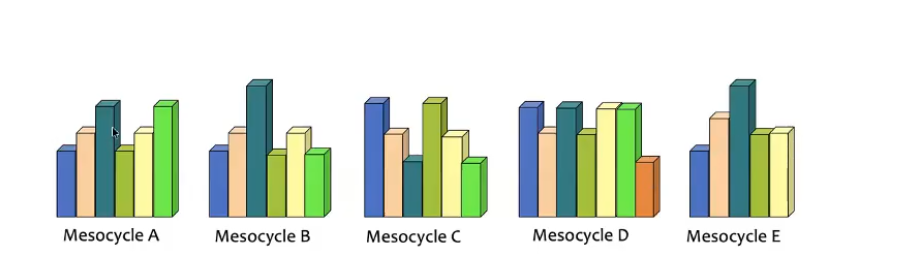
This graph shows the distribution of training loads (volume and intensity as a percentage) over a 6-week period, which are the five groups (A, B, C, D, E).
- Group (Model A) - Double Gradual Increase: The load gradually increases during the first 3 weeks, then decreases in the fourth week before rising again to a new peak in the sixth week. This is excellent for general preparation periods to increase and withstand planned exertion.
- Group (Model B) - Single upward then downward progression: The load gradually increases until the fourth week (peak 90%) and then gradually decreases to give the player a chance to recover.
- Group (Model C) - Double Downward Gradient: It starts with very high loads and then gradually decreases over two cycles to unload the loads.
- Group (Model D) - Ascent then Stabilization: Gradual ascent for the first 3 weeks, then stabilization on a constant and high load (80%) to maintain adaptation.
- Group (Model E) - Tapered Wave: Characterized by fluctuating loads up and down, ending with a very low load week (30%), this is the ideal model just before competitions to eliminate accumulated fatigue and bring the nervous system to peak efficiency.
Warning to coaches: Unplanned increases in loads and jumps for young athletes lead to skeletal injuries, often mistakenly attributed to "bad luck" when in fact they are the result of an error in training planning.
Seventh: Key quotes from the context
"The information itself hasn't changed in the last 40 years... What has changed is the concept; we now understand more why things happen and why they don't happen."
"In jumping competitions, intensity is the most important thing. Intensity is what allows me to get a result, and size comes later to repeat this result."
"Less than 5% of juniors who achieve world-class levels can replicate the same success as adults... and the reason is often errors in training methodology and intensifying high effort at an early age."
"The technique must be efficient. The more you can control the balance between speed and power, the easier and more effective the take-off becomes."
Glossary
| The term | Definition |
|---|---|
| Bio-motor Abilities | These include speed, strength, and endurance, which are the fundamental pillars upon which any physical exercise is built. |
| Recovery | The process by which the body regains its balance and energy after physical exertion, and it is an integral part of planning for success. |
| Maximum Intensity | Performance ranging from 95% to 100% of the player's ability is essential for developing explosive power in jumping. |
| Anaerobic energy system | Physical work that relies on the chemical energy reserves in the muscle without the need for oxygen, and is used in short, intense efforts. |
| Microcycle training course | A training structure that usually extends for a week, which determines the distribution of loads and rest periods in a sequential manner. |
| Take-off | The critical moment when the horizontal approach speed is transformed into a vertical or radial thrust to initiate flight. |
| Rhythm | The coordination and speed of the steps during the approach phase, which paves the way for proper ascent. |
| Central nervous system (CNS) | The system responsible for neuromuscular coordination and harmony; fatigue of this system leads to a loss of "quality" in athletic performance. |
| Training Load | The sum of the volume (repetitions and time) and intensity (difficulty of performance) that the player experiences during the exercise. |
| Development Rate | The percentage of improvement expected in technical or numerical performance based on age group (e.g., 5% improvement in pole vaulting for juniors). |

Witness
Read

Listen

interaction